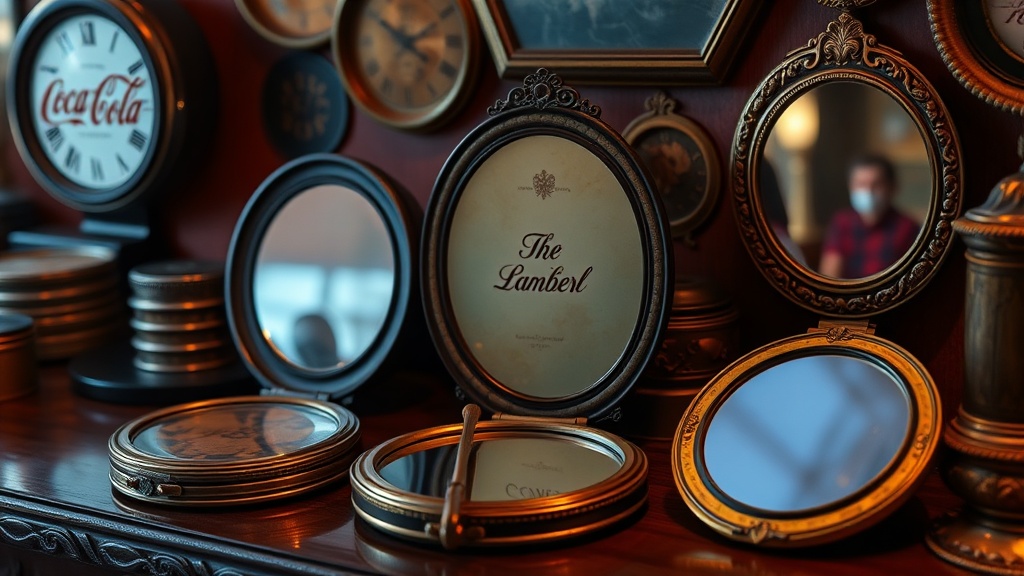
The Collector's Checklist for High-Value Antique Advertising Pocket Mirrors

Have you ever found yourself staring at a tiny, circular piece of history tucked away in a velvet-lined display case and wondered why the price tag has three zeros? It's a common reaction for those new to the world of "smalls," especially when dealing with antique advertising pocket mirrors. These miniature artifacts—mostly produced between 1895 and 1920—weren't just vanity items; they were some of the most effective portable billboards of the early 20th century. This guide digs into what makes these celluloid treasures so collectible, how to spot a rarity, and why their value continues to climb among serious hobbyists.
What makes a celluloid mirror worth more than its weight in gold?
When you're scanning a table at an antique show, it's easy to overlook these two-to-three-inch discs. However, for a collector, the value isn't in the silvered glass on the back, but in the lithographed celluloid on the front. The rarity of the advertisement is the primary driver of price. While a common insurance company mirror might only fetch twenty bucks, a rare brewer or a defunct tobacco brand can easily clear five hundred. Collectors often focus on specific niches—brewing, soda, farm machinery, or even political campaigns—and they're willing to pay a premium to fill a gap in their display. You can see some of the staggering price differences by checking out historical sales on LiveAuctioneers, where high-end examples are frequently traded.
The printing process itself adds to the allure. Before the age of digital everything, these mirrors used high-quality stone lithography. This produced vibrant colors and fine details that modern printing just can't replicate. If you look closely with a loupe, you'll see the distinct dot patterns or smooth color transitions that indicate an early production. The subject matter also plays a huge role; "pretty girl" mirrors were incredibly popular, but those featuring specific products or mascots—think the early Coca-Cola girls or the Buster Brown characters—are the ones that really get the bidding wars started. It's about that perfect intersection of graphic design, brand history, and surviving condition.
How do you identify a genuine early 20th-century advertisement?
Authenticity is a big deal because reproductions do exist, though they're usually easy to spot if you know what to look for. One of the best ways to verify an original is to check for the manufacturer's mark. The heavy hitters of the era were companies like Whitehead & Hoag Co. out of Newark, New Jersey, and the Parisian Novelty Co. from Chicago. These makers almost always stamped their name or patent dates along the narrow rim of the celluloid (the part that wraps around the mirror frame). If the graphics look too crisp or the "aging" looks like it was printed on rather than earned through a century of existence, walk away. Genuine mirrors often have a slight "yellowing" to the celluloid or tiny surface scratches from being carried in a pocket—though obviously, the cleaner the better.
Another telltale sign is the construction of the mirror itself. Antique mirrors usually have a cardboard or metal backing behind the glass, which you can sometimes hear if you give the piece a very gentle shake (don't overdo it, though). The weight should feel substantial for its size. Modern knock-offs often use cheaper plastics that feel light and "clicky" rather than the dense, smooth feel of genuine celluloid. If you're looking for more background on the companies that produced these, Collectors Weekly offers a great overview of the industry's peak years. Remember, a lack of a maker's mark isn't a total dealbreaker, but it should definitely make you look twice at the lithography quality.
Which industries produced the most sought-after pocket mirrors?
While almost every business from local bakeries to national railroads used pocket mirrors for promotion, certain industries are much more desirable today. Alcohol and tobacco advertisements are perennially at the top of the list. Pre-Prohibition beer mirrors are especially prized because many of those breweries didn't survive the dry years, making their promotional items relatively rare. You'll often find stunning graphics of foaming mugs, brewery buildings, or even the delivery wagons of the era. These pieces aren't just ads; they're snapshots of a local economy that no longer exists—which is exactly why guys like me love them.
Farm machinery and automotive mirrors are another high-demand category. Companies like John Deere or early car manufacturers used mirrors to reach the husbands (who would then give them to their wives). This cross-over appeal means you're competing with advertising collectors, tractor enthusiasts, and car buffs all at once. That competition drives prices up. On the flip side, you might find some great deals in "service" industries—old banks, insurance agents, or laundry services. While they might not have the flash of a whiskey ad, they often feature charming local history and can be a more affordable entry point for someone just starting their collection of smalls. For a deeper look at how these companies marketed themselves, the Advertising Hall of Fame resources can provide some fascinating context on early 20th-century branding strategies.
Why condition is the ultimate tie-breaker
In the world of small collectibles, condition is everything. Because celluloid is an organic-based plastic, it's susceptible to something collectors call "crazing"—those tiny spider-web cracks that happen when the material dries out or is exposed to extreme temperature swings. A mirror with heavy crazing or foxing (brown spots) on the glass will lose 50% to 70% of its value compared to a mint example. It's frustrating, I know, but that's the game. You want to see a smooth, glossy surface with no stains or "lifting" where the celluloid meets the metal rim. If the mirror glass is cracked, it's usually considered a "space filler" unless the front is exceptionally rare. Keep your mirrors in a climate-controlled environment, away from direct sunlight, if you want them to hold their value over the next few decades.
The thrill of the hunt for regional rarities
Part of the fun is finding mirrors from your own backyard. Many small-town businesses ordered these in small batches, meaning there might only be a handful of survivors from a specific Burlington dry goods store or a Vermont creamery. These regional pieces might not have the national draw of a Pepsi-Cola mirror, but to a local historian or a specialized collector, they are priceless. I always tell people to check the bargain bins at multi-dealer malls. Often, a dealer who specializes in large furniture or glassware won't bother to research a small mirror, labeling it simply as "Old Mirror - $10." That's where you make your best finds—and honestly, that's what keeps most of us coming back to the flea markets at five in the morning.